原生组件
如果你想构建 新的 封装了 宿主组件 的 React Native 组件,例如 Android 上一种独特的 CheckBox,或者 iOS 上的 UIButton,你应该使用 Fabric 原生组件。
本指南将通过实现一个 web view 组件来展示如何构建 Fabric 原生组件。步骤如下:
- 使用 Flow 或 TypeScript 定义 JavaScript 规范。
- 配置依赖管理系统以根据提供的规范生成代码并自动链接。
- 实现原生代码。
- 在 App 中使用该组件。
你需要一个普通模板生成的应用来使用该组件:
npx @react-native-community/cli@latest init Demo --install-pods false
创建 WebView 组件
本指南将展示如何创建一个 Web View 组件。我们将使用 Android 的 WebView 组件和 iOS 的 WKWebView 组件来创建该组件。
首先,让我们创建文件夹结构来存放组件的代码:
mkdir -p Demo/{specs,android/app/src/main/java/com/webview}
这将为你提供以下工作布局:
Demo
├── android/app/src/main/java/com/webview
└── ios
└── specs
android/app/src/main/java/com/webview文件夹是包含我们 Android 代码的文件夹。ios文件夹是包含我们 iOS 代码的文件夹。specs文件夹是包含 Codegen 规范文件的文件夹。
1. 为 Codegen 定义规范
你的规范必须定义在 TypeScript 或 Flow 中(详见 Codegen 文档)。Codegen 使用它来生成 C++、Objective-C++ 和 Java 代码,以将你的平台代码连接到 React 运行的 JavaScript 运行时。
规范文件必须命名为 <MODULE_NAME>NativeComponent.{ts|js} 才能与 Codegen 一起工作。后缀 NativeComponent 不仅是一个约定,它实际上被 Codegen 用于检测规范文件。
为我们的 WebView 组件使用此规范:
- TypeScript
- Flow
import type {HostComponent, ViewProps} from 'react-native';
import type {BubblingEventHandler} from 'react-native/Libraries/Types/CodegenTypes';
import codegenNativeComponent from 'react-native/Libraries/Utilities/codegenNativeComponent';

type WebViewScriptLoadedEvent = {
  result: 'success' | 'error';
};

export interface NativeProps extends ViewProps {
  sourceURL?: string;
  onScriptLoaded?: BubblingEventHandler<WebViewScriptLoadedEvent> | null;
}

export default codegenNativeComponent<NativeProps>(
  'CustomWebView',
) as HostComponent<NativeProps>;
// @flow strict-local

import type {HostComponent, ViewProps} from 'react-native';
import type {BubblingEventHandler} from 'react-native/Libraries/Types/CodegenTypes';
import codegenNativeComponent from 'react-native/Libraries/Utilities/codegenNativeComponent';

type WebViewScriptLoadedEvent = $ReadOnly<{|
  result: "success" | "error",
|}>;

type NativeProps = $ReadOnly<{|
  ...ViewProps,
  sourceURL?: string;
  onScriptLoaded?: BubblingEventHandler<WebViewScriptLoadedEvent>?;
|}>;

export default (codegenNativeComponent<NativeProps>(
  'CustomWebView',
): HostComponent<NativeProps>);
此规范由三个主要部分组成,不包括导入:
WebViewScriptLoadedEvent是事件需要从原生传递到 JavaScript 的数据的支持数据类型。NativeProps是我们可以设置在组件上的 props 的定义。codegenNativeComponent语句允许我们为自定义组件生成代码,并定义一个用于匹配原生实现的组件名称。
与原生模块一样,你可以在 specs/ 目录中拥有多个规范文件。有关你可以使用的类型以及这些类型映射到的平台类型的更多信息,请参阅 附录。
2. 配置 Codegen 运行
规范被 React Native 的 Codegen 工具用于为我们生成平台特定的接口和样板代码。为此,Codegen 需要知道在哪里找到我们的规范以及如何处理它。更新你的 package.json 以包含:
    "start": "react-native start",
    "test": "jest"
  },
  "codegenConfig": {
    "name": "AppSpec",
    "type": "components",
    "jsSrcsDir": "specs",
    "android": {
      "javaPackageName": "com.webview"
    },
    "ios": {
      "componentProvider": {
        "CustomWebView": "RCTWebView"
      }
    }
  },
  "dependencies": {
一切都为 Codegen 连接好后,我们需要准备原生代码以接入我们生成的代码。
注意对于 iOS,我们声明式地将规范导出的 JS 组件名称(CustomWebView)与将在原生实现该组件的 iOS 类进行映射。
2. 构建原生代码
现在是编写原生平台代码的时候了,这样当 React 需要渲染视图时,平台可以创建正确的原生视图并将其渲染在屏幕上。
你应该同时处理 Android 和 iOS 平台。
本指南展示如何创建仅适用于新架构的原生组件。如果你需要同时支持新架构和旧架构,请参阅我们的 向后兼容指南。
- Android
- iOS
现在是时候编写一些 Android 平台代码以便能够渲染 web 视图了。你需要遵循的步骤是:
- 运行 Codegen
- 编写
ReactWebView的代码 - 编写
ReactWebViewManager的代码 - 编写
ReactWebViewPackage的代码 - 在应用程序中注册
ReactWebViewPackage
1. 通过 Gradle 运行 Codegen
运行一次此命令以生成你的首选 IDE 可以使用的样板代码。
cd android
./gradlew generateCodegenArtifactsFromSchema
Codegen 将生成你需要实现的 ViewManager 接口和 web 视图的 ViewManager 委托。
2. 编写 ReactWebView
ReactWebView 是当我们使用自定义组件时,React Native 将渲染的包装 Android 原生视图的组件。
在 android/src/main/java/com/webview 文件夹中创建一个带有此代码的 ReactWebView.java 或 ReactWebView.kt 文件:
- Java
- Kotlin
package com.webview;

import android.content.Context;
import android.util.AttributeSet;
import android.webkit.WebView;
import android.webkit.WebViewClient;

import com.facebook.react.bridge.Arguments;
import com.facebook.react.bridge.WritableMap;
import com.facebook.react.bridge.ReactContext;
import com.facebook.react.uimanager.UIManagerHelper;
import com.facebook.react.uimanager.events.Event;

public class ReactWebView extends WebView {
  public ReactWebView(Context context) {
    super(context);
    configureComponent();
  }

  public ReactWebView(Context context, AttributeSet attrs) {
    super(context, attrs);
    configureComponent();
  }

  public ReactWebView(Context context, AttributeSet attrs, int defStyleAttr) {
    super(context, attrs, defStyleAttr);
    configureComponent();
  }

  private void configureComponent() {
    this.setLayoutParams(new LayoutParams(LayoutParams.MATCH_PARENT, LayoutParams.MATCH_PARENT));
    this.setWebViewClient(new WebViewClient() {
      @Override
      public void onPageFinished(WebView view, String url) {
        emitOnScriptLoaded(OnScriptLoadedEventResult.success);
      }
    });
  }

  public void emitOnScriptLoaded(OnScriptLoadedEventResult result) {
    ReactContext reactContext = (ReactContext) context;
    int surfaceId = UIManagerHelper.getSurfaceId(reactContext);
    EventDispatcher eventDispatcher = UIManagerHelper.getEventDispatcherForReactTag(reactContext, getId());
    WritableMap payload = Arguments.createMap();
    payload.putString("result", result.name());

    OnScriptLoadedEvent event = new OnScriptLoadedEvent(surfaceId, getId(), payload);
    if (eventDispatcher != null) {
      eventDispatcher.dispatchEvent(event);
    }
  }

  public enum OnScriptLoadedEventResult {
    success,
    error
  }

  private class OnScriptLoadedEvent extends Event<OnScriptLoadedEvent> {
    private final WritableMap payload;

    OnScriptLoadedEvent(int surfaceId, int viewId, WritableMap payload) {
      super(surfaceId, viewId);
      this.payload = payload;
    }

    @Override
    public String getEventName() {
      return "onScriptLoaded";
    }

    @Override
    public WritableMap getEventData() {
      return payload;
    }
  }
}
package com.webview

import android.content.Context
import android.util.AttributeSet
import android.webkit.WebView
import android.webkit.WebViewClient
import com.facebook.react.bridge.Arguments
import com.facebook.react.bridge.WritableMap
import com.facebook.react.bridge.ReactContext
import com.facebook.react.uimanager.UIManagerHelper
import com.facebook.react.uimanager.events.Event

class ReactWebView: WebView {
  constructor(context: Context) : super(context) {
    configureComponent()
  }

  constructor(context: Context, attrs: AttributeSet?) : super(context, attrs) {
    configureComponent()
  }

  constructor(context: Context, attrs: AttributeSet?, defStyleAttr: Int) : super(context, attrs, defStyleAttr) {
    configureComponent()
  }

  private fun configureComponent() {
    this.layoutParams = LayoutParams(LayoutParams.MATCH_PARENT, LayoutParams.MATCH_PARENT)
    this.webViewClient = object : WebViewClient() {
      override fun onPageFinished(view: WebView, url: String) {
        emitOnScriptLoaded(OnScriptLoadedEventResult.success)
      }
    }
  }

  fun emitOnScriptLoaded(result: OnScriptLoadedEventResult) {
    val reactContext = context as ReactContext
    val surfaceId = UIManagerHelper.getSurfaceId(reactContext)
    val eventDispatcher = UIManagerHelper.getEventDispatcherForReactTag(reactContext, id)
    val payload =
        Arguments.createMap().apply {
          putString("result", result.name)
        }
    val event = OnScriptLoadedEvent(surfaceId, id, payload)

    eventDispatcher?.dispatchEvent(event)
  }

  enum class OnScriptLoadedEventResult {
    success,
    error;
  }

  inner class OnScriptLoadedEvent(
      surfaceId: Int,
      viewId: Int,
      private val payload: WritableMap
  ) : Event<OnScriptLoadedEvent>(surfaceId, viewId) {
    override fun getEventName() = "onScriptLoaded"

    override fun getEventData() = payload
  }
}
ReactWebView 扩展了 Android 的 WebView,因此你可以轻松地重用平台已经定义的所有属性。
该类定义了三个 Android 构造函数,但将其实际实现委托给私有 configureComponent 函数。此函数负责初始化所有组件特定属性:在这种情况下,你正在设置 WebView 的布局,并且正在定义用于自定义 WebView 行为的 WebClient。在此代码中,ReactWebView 通过实现 WebClient 的 onPageFinished 方法,在页面完成加载时发出事件。
然后代码定义了一个辅助函数来实际发出事件。要发出事件,你必须:
- 获取
ReactContext的引用; - 检索你正在呈现的视图的
surfaceId; - 获取与视图关联的
eventDispatcher的引用; - 使用
WritableMap对象构建事件的有效负载; - 创建你需要发送到 JavaScript 的事件对象;
- 调用
eventDispatcher.dispatchEvent发送事件。
文件的最后一部分包含发送事件所需的数据类型定义:
OnScriptLoadedEventResult,带有OnScriptLoaded事件的可能结果。- 实际的
OnScriptLoadedEvent,需要扩展 React Native 的Event类。
3. 编写 WebViewManager
WebViewManager 是将 React Native 运行时与原生视图连接起来的类。
当 React 收到来自应用程序渲染特定组件的指令时,React 使用注册的视图管理器来创建视图并传递所有所需的属性。
这是 ReactWebViewManager 的代码。
- Java
- Kotlin
package com.webview;

import com.facebook.react.bridge.ReactApplicationContext;
import com.facebook.react.module.annotations.ReactModule;
import com.facebook.react.uimanager.SimpleViewManager;
import com.facebook.react.uimanager.ThemedReactContext;
import com.facebook.react.uimanager.ViewManagerDelegate;
import com.facebook.react.uimanager.annotations.ReactProp;
import com.facebook.react.viewmanagers.CustomWebViewManagerInterface;
import com.facebook.react.viewmanagers.CustomWebViewManagerDelegate;

import java.util.HashMap;
import java.util.Map;

@ReactModule(name = ReactWebViewManager.REACT_CLASS)
class ReactWebViewManager extends SimpleViewManager<ReactWebView> implements CustomWebViewManagerInterface<ReactWebView> {
  private final CustomWebViewManagerDelegate<ReactWebView, ReactWebViewManager> delegate =
          new CustomWebViewManagerDelegate<>(this);

  @Override
  public ViewManagerDelegate<ReactWebView> getDelegate() {
    return delegate;
  }

  @Override
  public String getName() {
    return REACT_CLASS;
  }

  @Override
  public ReactWebView createViewInstance(ThemedReactContext context) {
    return new ReactWebView(context);
  }

  @ReactProp(name = "sourceUrl")
  @Override
  public void setSourceURL(ReactWebView view, String sourceURL) {
    if (sourceURL == null) {
      view.emitOnScriptLoaded(ReactWebView.OnScriptLoadedEventResult.error);
      return;
    }
    view.loadUrl(sourceURL, new HashMap<>());
  }

  public static final String REACT_CLASS = "CustomWebView";

  @Override
  public Map<String, Object> getExportedCustomBubblingEventTypeConstants() {
    Map<String, Object> map = new HashMap<>();
    Map<String, Object> bubblingMap = new HashMap<>();
    bubblingMap.put("phasedRegistrationNames", new HashMap<String, String>() {{
      put("bubbled", "onScriptLoaded");
      put("captured", "onScriptLoadedCapture");
    }});
    map.put("onScriptLoaded", bubblingMap);
    return map;
  }
}
package com.webview

import com.facebook.react.bridge.ReactApplicationContext;
import com.facebook.react.module.annotations.ReactModule;
import com.facebook.react.uimanager.SimpleViewManager;
import com.facebook.react.uimanager.ThemedReactContext;
import com.facebook.react.uimanager.ViewManagerDelegate;
import com.facebook.react.uimanager.annotations.ReactProp;
import com.facebook.react.viewmanagers.CustomWebViewManagerInterface;
import com.facebook.react.viewmanagers.CustomWebViewManagerDelegate;

@ReactModule(name = ReactWebViewManager.REACT_CLASS)
class ReactWebViewManager(context: ReactApplicationContext) : SimpleViewManager<ReactWebView>(), CustomWebViewManagerInterface<ReactWebView> {
  private val delegate: CustomWebViewManagerDelegate<ReactWebView, ReactWebViewManager> =
    CustomWebViewManagerDelegate(this)

  override fun getDelegate(): ViewManagerDelegate<ReactWebView> = delegate

  override fun getName(): String = REACT_CLASS

  override fun createViewInstance(context: ThemedReactContext): ReactWebView = ReactWebView(context)

  @ReactProp(name = "sourceUrl")
  override fun setSourceURL(view: ReactWebView, sourceURL: String?) {
    if (sourceURL == null) {
      view.emitOnScriptLoaded(ReactWebView.OnScriptLoadedEventResult.error)
      return;
    }
    view.loadUrl(sourceURL, emptyMap())
  }

  companion object {
    const val REACT_CLASS = "CustomWebView"
  }

  override fun getExportedCustomBubblingEventTypeConstants(): Map<String, Any> =
      mapOf(
          "onScriptLoaded" to
              mapOf(
                  "phasedRegistrationNames" to
                      mapOf(
                          "bubbled" to "onScriptLoaded",
                          "captured" to "onScriptLoadedCapture"
                      )))
}
ReactWebViewManager 扩展了 React 的 SimpleViewManager 类并实现了由 Codegen 生成的 CustomWebViewManagerInterface。
它持有 CustomWebViewManagerDelegate 的引用,这是由 Codegen 生成的另一个元素。
然后它重写 getName 函数,该函数必须返回与 spec 的 codegenNativeComponent 函数调用中使用的名称相同的名称。
createViewInstance 函数负责实例化一个新的 ReactWebView。
然后,ViewManager 需要定义所有 React 组件的 props 将如何更新原生视图。在示例中,你需要决定如何处理 React 将在 WebView 上设置的 sourceURL 属性。
最后,如果组件可以发出事件,你需要通过重写 getExportedCustomBubblingEventTypeConstants 来映射冒泡事件的事件名称,或者通过 getExportedCustomDirectEventTypeConstants 来映射直接事件。
4. 编写 ReactWebViewPackage
就像你对原生模块所做的那样,原生组件也需要实现 ReactPackage 类。这是一个你可以用来在 React Native 运行时中注册组件的对象。
这是 ReactWebViewPackage 的代码:
- Java
- Kotlin
package com.webview;

import com.facebook.react.BaseReactPackage;
import com.facebook.react.bridge.NativeModule;
import com.facebook.react.bridge.ReactApplicationContext;
import com.facebook.react.module.model.ReactModuleInfo;
import com.facebook.react.module.model.ReactModuleInfoProvider;
import com.facebook.react.uimanager.ViewManager;

import java.util.Collections;
import java.util.HashMap;
import java.util.List;
import java.util.Map;

public class ReactWebViewPackage extends BaseReactPackage {
  @Override
  public List<ViewManager<?, ?>> createViewManagers(ReactApplicationContext reactContext) {
    return Collections.singletonList(new ReactWebViewManager(reactContext));
  }

  @Override
  public NativeModule getModule(String s, ReactApplicationContext reactApplicationContext) {
    if (ReactWebViewManager.REACT_CLASS.equals(s)) {
      return new ReactWebViewManager(reactApplicationContext);
    }
    return null;
  }

  @Override
  public ReactModuleInfoProvider getReactModuleInfoProvider() {
    return new ReactModuleInfoProvider() {
      @Override
      public Map<String, ReactModuleInfo> getReactModuleInfos() {
        Map<String, ReactModuleInfo> map = new HashMap<>();
        map.put(ReactWebViewManager.REACT_CLASS, new ReactModuleInfo(
                ReactWebViewManager.REACT_CLASS, // 名称
                ReactWebViewManager.REACT_CLASS, // 类名
                false,                           // 是否可以覆盖现有模块
                false,                           // 是否需要急切初始化
                false,                           // 是否是 Cxx 模块
                true                             // 是否是 Turbo 模块
        ));
        return map;
      }
    };
  }
}
package com.webview

import com.facebook.react.BaseReactPackage
import com.facebook.react.bridge.NativeModule
import com.facebook.react.bridge.ReactApplicationContext
import com.facebook.react.module.model.ReactModuleInfo
import com.facebook.react.module.model.ReactModuleInfoProvider
import com.facebook.react.uimanager.ViewManager

class ReactWebViewPackage : BaseReactPackage() {
  override fun createViewManagers(reactContext: ReactApplicationContext): List<ViewManager<*, *>> {
    return listOf(ReactWebViewManager(reactContext))
  }

  override fun getModule(s: String, reactApplicationContext: ReactApplicationContext): NativeModule? {
    when (s) {
      ReactWebViewManager.REACT_CLASS -> ReactWebViewManager(reactApplicationContext)
    }
    return null
  }

  override fun getReactModuleInfoProvider(): ReactModuleInfoProvider = ReactModuleInfoProvider {
    mapOf(ReactWebViewManager.REACT_CLASS to ReactModuleInfo(
      name = ReactWebViewManager.REACT_CLASS,
      className = ReactWebViewManager.REACT_CLASS,
      canOverrideExistingModule = false,
      needsEagerInit = false,
      isCxxModule = false,
      isTurboModule = true,
    )
    )
  }
}
ReactWebViewPackage 扩展了 BaseReactPackage 并实现了正确注册我们组件所需的所有方法。
createViewManagers方法是创建管理自定义视图的ViewManager的工厂方法。getModule方法根据 React Native 需要渲染的视图返回适当的 ViewManager。getReactModuleInfoProvider提供在运行时注册模块时所需的所有信息。
5. 在应用程序中注册 ReactWebViewPackage
最后,你需要在应用程序中注册 ReactWebViewPackage。我们通过修改 MainApplication 文件并将 ReactWebViewPackage 添加到 getPackages 函数返回的包列表中来做到这一点。
package com.demo

import android.app.Application
import com.facebook.react.PackageList
import com.facebook.react.ReactApplication
import com.facebook.react.ReactHost
import com.facebook.react.ReactNativeHost
import com.facebook.react.ReactPackage
import com.facebook.react.defaults.DefaultNewArchitectureEntryPoint.load
import com.facebook.react.defaults.DefaultReactHost.getDefaultReactHost
import com.facebook.react.defaults.DefaultReactNativeHost
import com.facebook.react.soloader.OpenSourceMergedSoMapping
import com.facebook.soloader.SoLoader
import com.webview.ReactWebViewPackage

class MainApplication : Application(), ReactApplication {

  override val reactNativeHost: ReactNativeHost =
      object : DefaultReactNativeHost(this) {
        override fun getPackages(): List<ReactPackage> =
            PackageList(this).packages.apply {
              add(ReactWebViewPackage())
            }

        override fun getJSMainModuleName(): String = "index"

        override fun getUseDeveloperSupport(): Boolean = BuildConfig.DEBUG

        override val isNewArchEnabled: Boolean = BuildConfig.IS_NEW_ARCHITECTURE_ENABLED
        override val isHermesEnabled: Boolean = BuildConfig.IS_HERMES_ENABLED
      }

  override val reactHost: ReactHost
    get() = getDefaultReactHost(applicationContext, reactNativeHost)

  override fun onCreate() {
    super.onCreate()
    SoLoader.init(this, OpenSourceMergedSoMapping)
    if (BuildConfig.IS_NEW_ARCHITECTURE_ENABLED) {
      load()
    }
  }
}
现在是时候编写一些 iOS 平台代码以便能够渲染 web 视图了。你需要遵循的步骤如下:
- 运行 Codegen。
- 编写
RCTWebView的代码 - 在应用程序中注册
RCTWebView
1. 运行 Codegen
你可以 手动运行 Codegen,然而更简单的方法是使用你将要演示该组件的应用程序来为你完成此操作。
cd ios
bundle install
bundle exec pod install
重要的是,你将看到来自 Codegen 的日志输出,我们将在 Xcode 中使用它来构建我们的 WebView 原生组件。
你应该小心不要将生成的代码提交到你的仓库。生成的代码特定于每个版本的 React Native。使用 npm peerDependencies 来限制与 React Native 版本的兼容性。
3. 编写 RCTWebView
我们需要通过完成以下 5 个步骤 来使用 Xcode 准备你的 iOS 项目:
- 打开 CocoaPods 生成的 Xcode Workspace:
cd ios
open Demo.xcworkspace
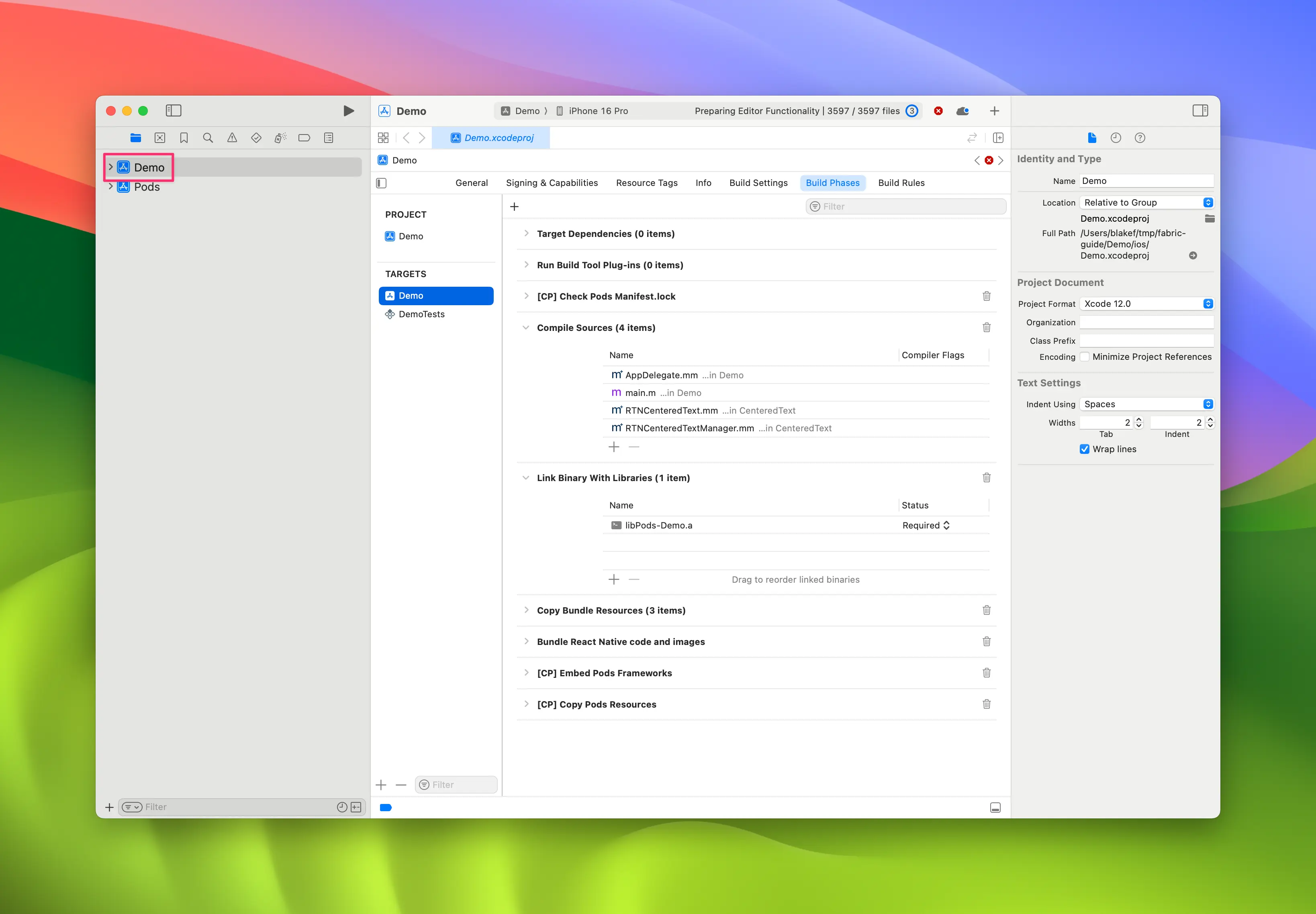
- 右键点击 app 并选择
新建组,将新组命名为WebView。
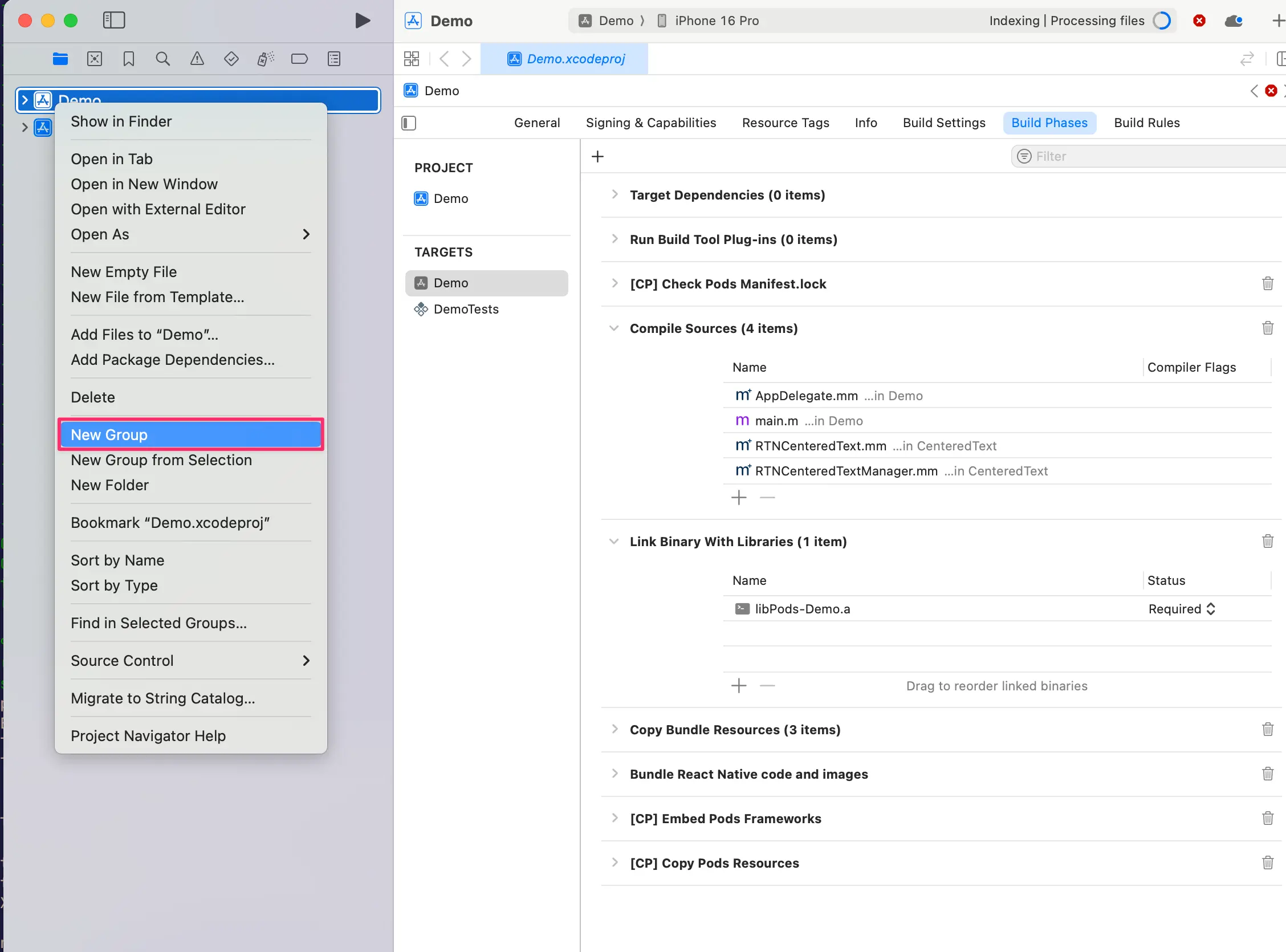
- 在
WebView组中,创建新建→从模板创建文件。
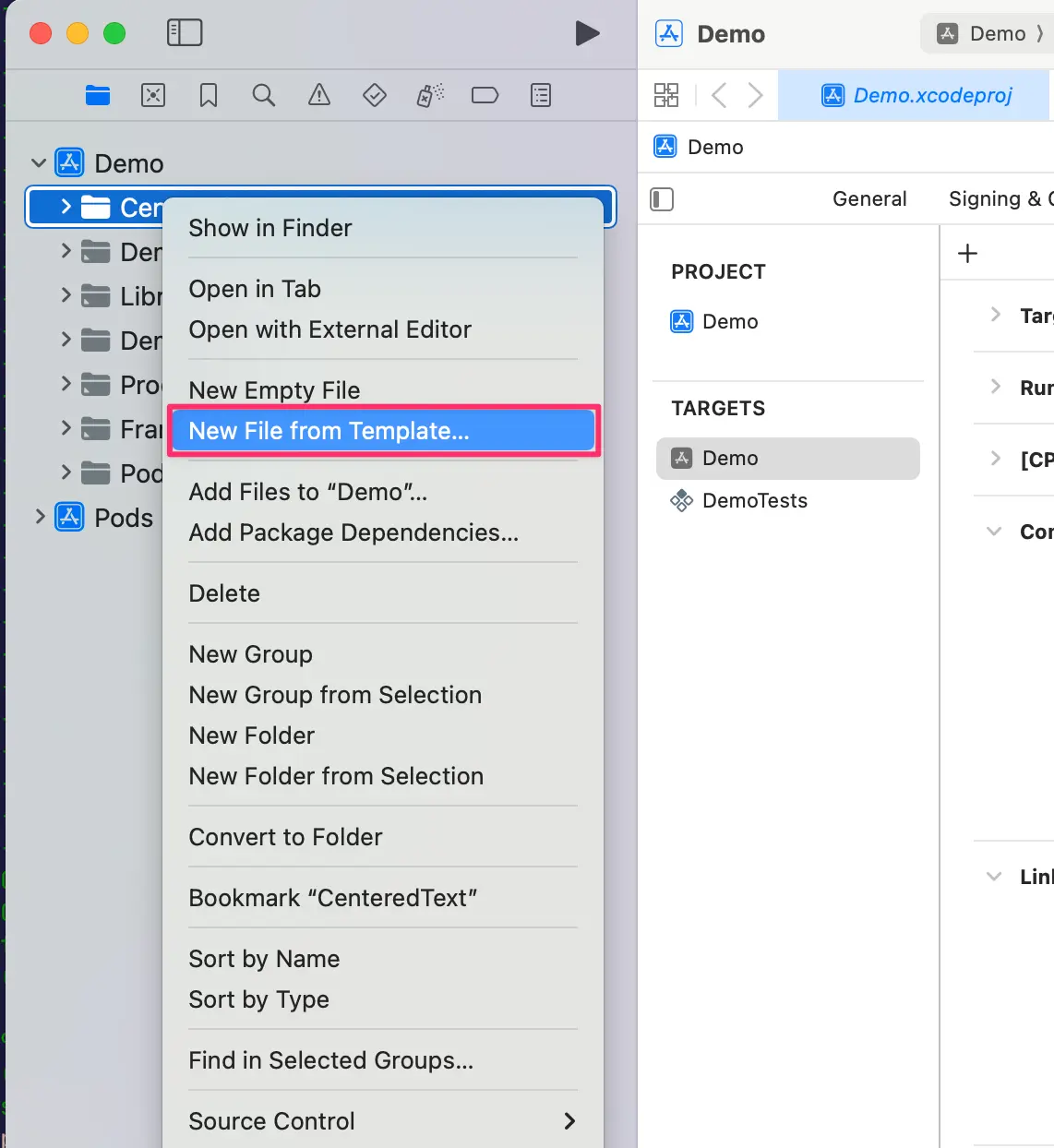
- 使用
Objective-C 文件模板,并将其命名为RCTWebView。
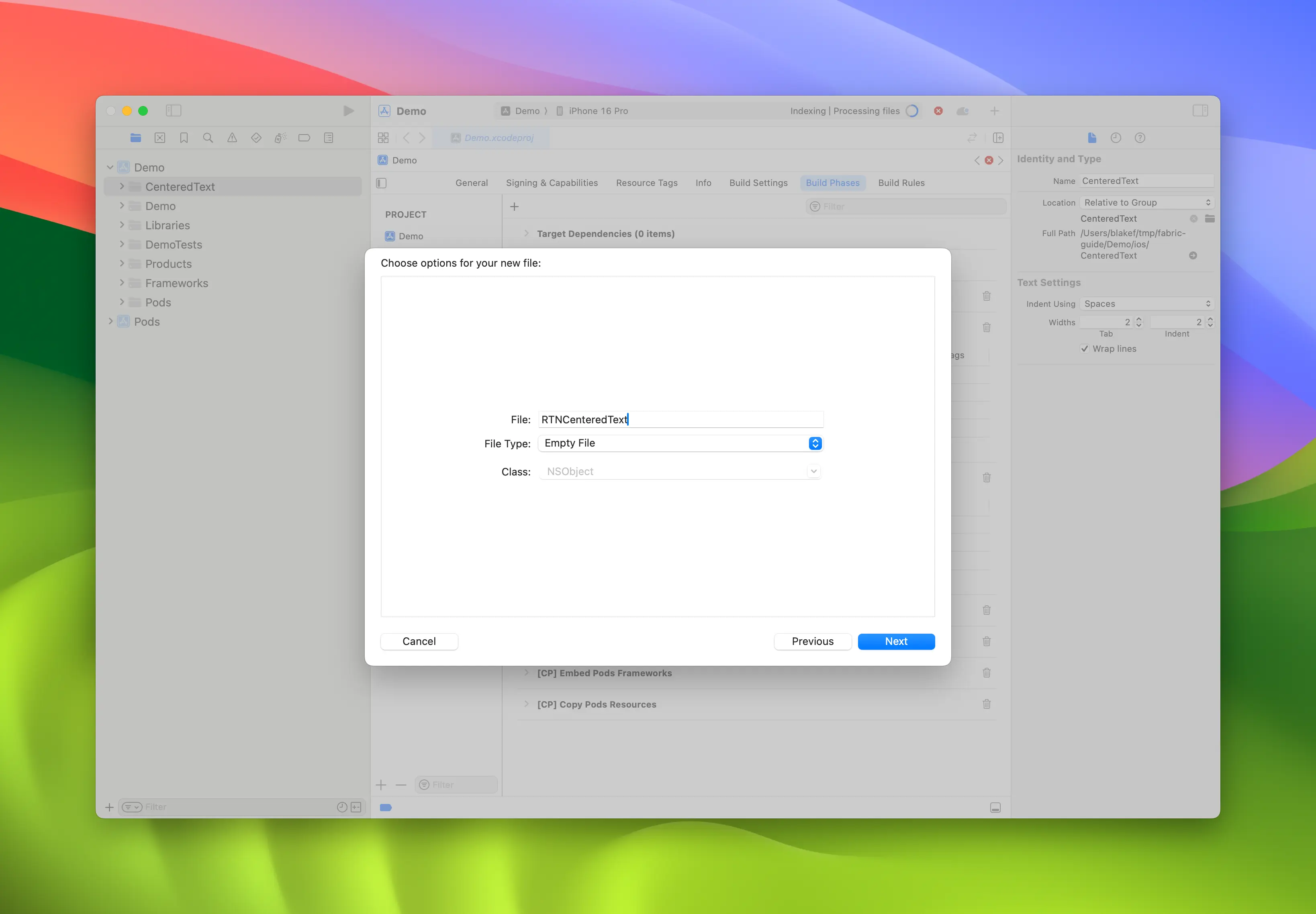
-
重复步骤 4 并创建一个名为
RCTWebView.h的头文件。 -
重命名
RCTWebView.m→RCTWebView.mm使其成为 Objective-C++ 文件。
Podfile
...
Demo
├── AppDelegate.swift
...
├── RCTWebView.h
└── RCTWebView.mm
创建头文件和实现文件后,你可以开始实现它们。
这是 RCTWebView.h 文件的代码,它声明了组件接口。
#import <React/RCTViewComponentView.h>
#import <UIKit/UIKit.h>

NS_ASSUME_NONNULL_BEGIN

@interface RCTWebView : RCTViewComponentView

// 你会在这里声明想要从视图访问的原生方法

@end

NS_ASSUME_NONNULL_END
此类定义了一个扩展了 RCTViewComponentView 类的 RCTWebView。这是所有原生组件的基类,由 React Native 提供。
实现文件 (RCTWebView.mm) 的代码如下:
#import "RCTWebView.h"

#import <react/renderer/components/AppSpec/ComponentDescriptors.h>
#import <react/renderer/components/AppSpec/EventEmitters.h>
#import <react/renderer/components/AppSpec/Props.h>
#import <react/renderer/components/AppSpec/RCTComponentViewHelpers.h>
#import <WebKit/WebKit.h>

using namespace facebook::react;

@interface RCTWebView () <RCTCustomWebViewViewProtocol, WKNavigationDelegate>
@end

@implementation RCTWebView {
  NSURL * _sourceURL;
  WKWebView * _webView;
}

-(instancetype)init
{
  if(self = [super init]) {
    _webView = [WKWebView new];
    _webView.navigationDelegate = self;
    [self addSubview:_webView];
  }
  return self;
}

- (void)updateProps:(Props::Shared const &)props oldProps:(Props::Shared const &)oldProps
{
  const auto &oldViewProps = *std::static_pointer_cast<CustomWebViewProps const>(_props);
  const auto &newViewProps = *std::static_pointer_cast<CustomWebViewProps const>(props);

  // 在这里处理你的 props
  if (oldViewProps.sourceURL != newViewProps.sourceURL) {
    NSString *urlString = [NSString stringWithCString:newViewProps.sourceURL.c_str() encoding:NSUTF8StringEncoding];
    _sourceURL = [NSURL URLWithString:urlString];
    if ([self urlIsValid:newViewProps.sourceURL]) {
      [_webView loadRequest:[NSURLRequest requestWithURL:_sourceURL]];
    }
  }

  [super updateProps:props oldProps:oldProps];
}

-(void)layoutSubviews
{
  [super layoutSubviews];
  _webView.frame = self.bounds;

}

#pragma mark - WKNavigationDelegate

-(void)webView:(WKWebView *)webView didFinishNavigation:(WKNavigation *)navigation
{
  CustomWebViewEventEmitter::OnScriptLoaded result = CustomWebViewEventEmitter::OnScriptLoaded{CustomWebViewEventEmitter::OnScriptLoadedResult::Success};
  self.eventEmitter.onScriptLoaded(result);
}

- (BOOL)urlIsValid:(std::string)propString
{
  if (propString.length() > 0 && !_sourceURL) {
    CustomWebViewEventEmitter::OnScriptLoaded result = CustomWebViewEventEmitter::OnScriptLoaded{CustomWebViewEventEmitter::OnScriptLoadedResult::Error};

    self.eventEmitter.onScriptLoaded(result);
    return NO;
  }
  return YES;
}

// 事件发射器便捷方法
- (const CustomWebViewEventEmitter &)eventEmitter
{
  return static_cast<const CustomWebViewEventEmitter &>(*_eventEmitter);
}

+ (ComponentDescriptorProvider)componentDescriptorProvider
{
  return concreteComponentDescriptorProvider<CustomWebViewComponentDescriptor>();
}

@end
这段代码是用 Objective-C++ 编写的,包含各种细节:
@interface实现了两个协议:RCTCustomWebViewViewProtocol,由 Codegen 生成;WKNavigationDelegate,由 WebKit 框架提供,用于处理 web 视图导航事件;
init方法,实例化WKWebView,将其添加到子视图并设置navigationDelegate;updateProps方法,当组件的 props 更改时由 React Native 调用;layoutSubviews方法,描述自定义视图需要如何布局;webView:didFinishNavigation:方法,让你处理WKWebView完成页面加载后的操作;urlIsValid:(std::string)propString方法,检查作为 prop 接收的 URL 是否有效;eventEmitter方法,这是一个用于检索强类型eventEmitter实例的工具componentDescriptorProvider,返回由 Codegen 生成的ComponentDescriptor;
添加 WebKit 框架
此步骤仅因为我们正在创建 Web 视图才是必需的。iOS 上的 Web 组件需要链接到 Apple 提供的 WebKit 框架。如果你的组件不需要访问 Web 特定功能,你可以跳过此步骤。
Web 视图需要访问 Apple 通过 Xcode 和设备附带的一个框架提供的一些功能:WebKit。
你可以在原生代码中通过添加到 RCTWebView.mm 中的 #import <WebKit/WebKit.h> 行看到它。
要在你的应用中链接 WebKit 框架,请遵循以下步骤:
- 在 Xcode 中,点击你的项目
- 选择 app target
- 选择 General 标签页
- 向下滚动直到找到 "框架、库和嵌入内容" 部分,然后点击
+按钮
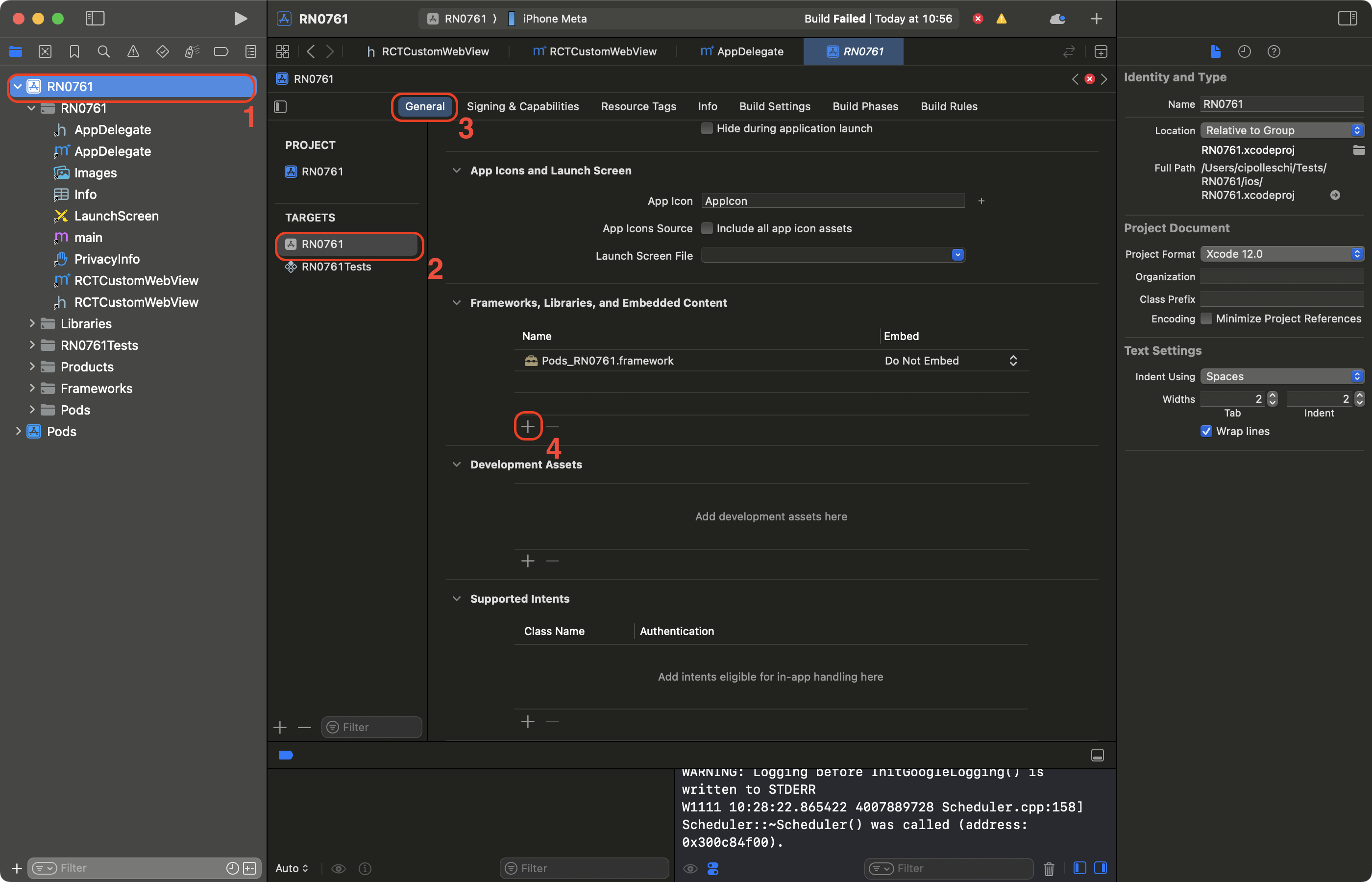
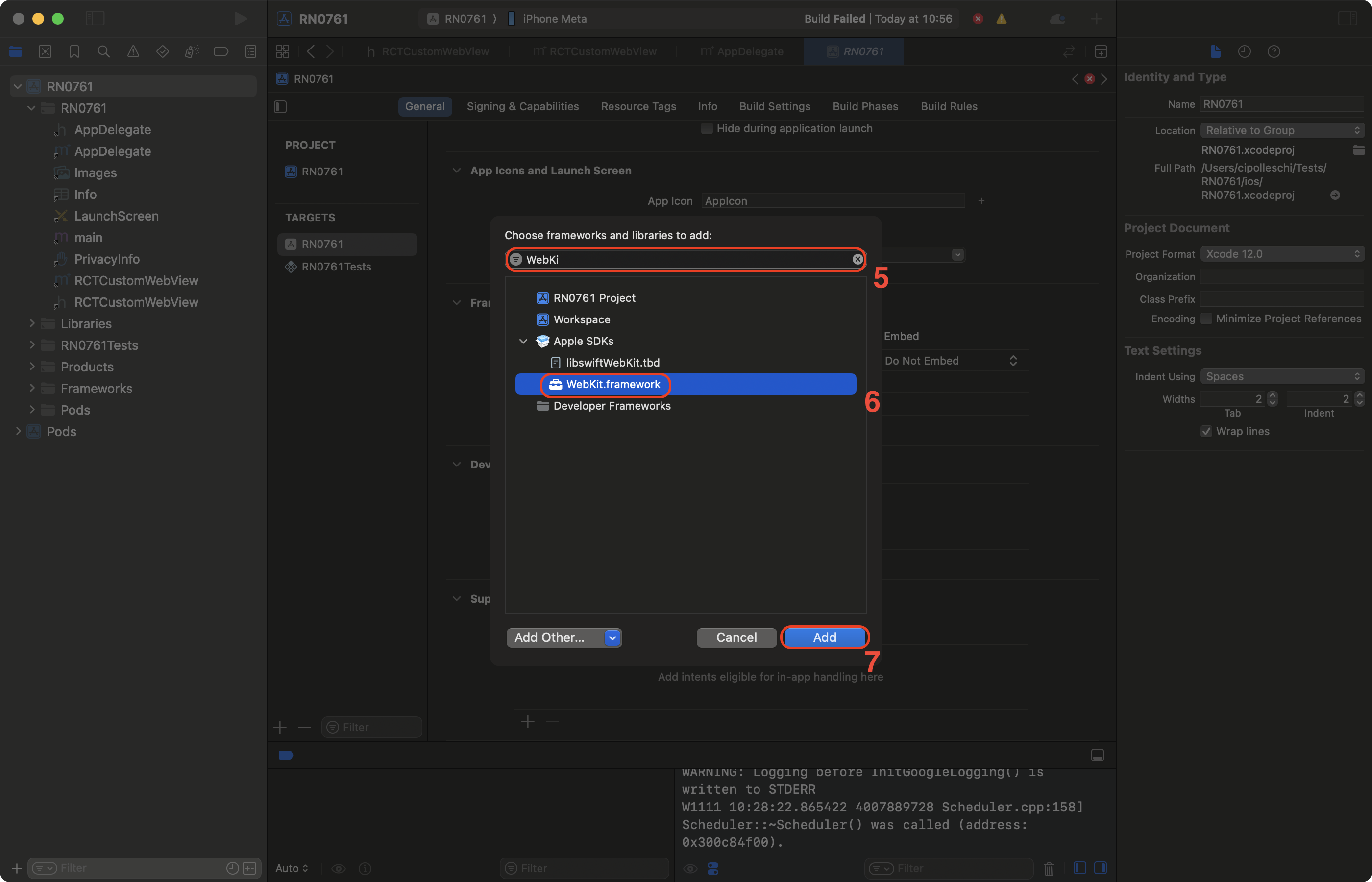
- 在搜索栏中,过滤搜索 WebKit
- 选择 WebKit 框架
- 点击添加。
3. 使用你的原生组件
最后,你可以在你的应用中使用新组件。更新你生成的 App.tsx 为:
import React from 'react';
import {Alert, StyleSheet, View} from 'react-native';
import WebView from './specs/WebViewNativeComponent';

function App(): React.JSX.Element {
  return (
    <View style={styles.container}>
      <WebView
        sourceURL="https://react.dev/"
        style={styles.webview}
        onScriptLoaded={() => {
          Alert.alert('Page Loaded');
        }}
      />
    </View>
  );
}

const styles = StyleSheet.create({
  container: {
    flex: 1,
    alignItems: 'center',
    alignContent: 'center',
  },
  webview: {
    width: '100%',
    height: '100%',
  },
});

export default App;
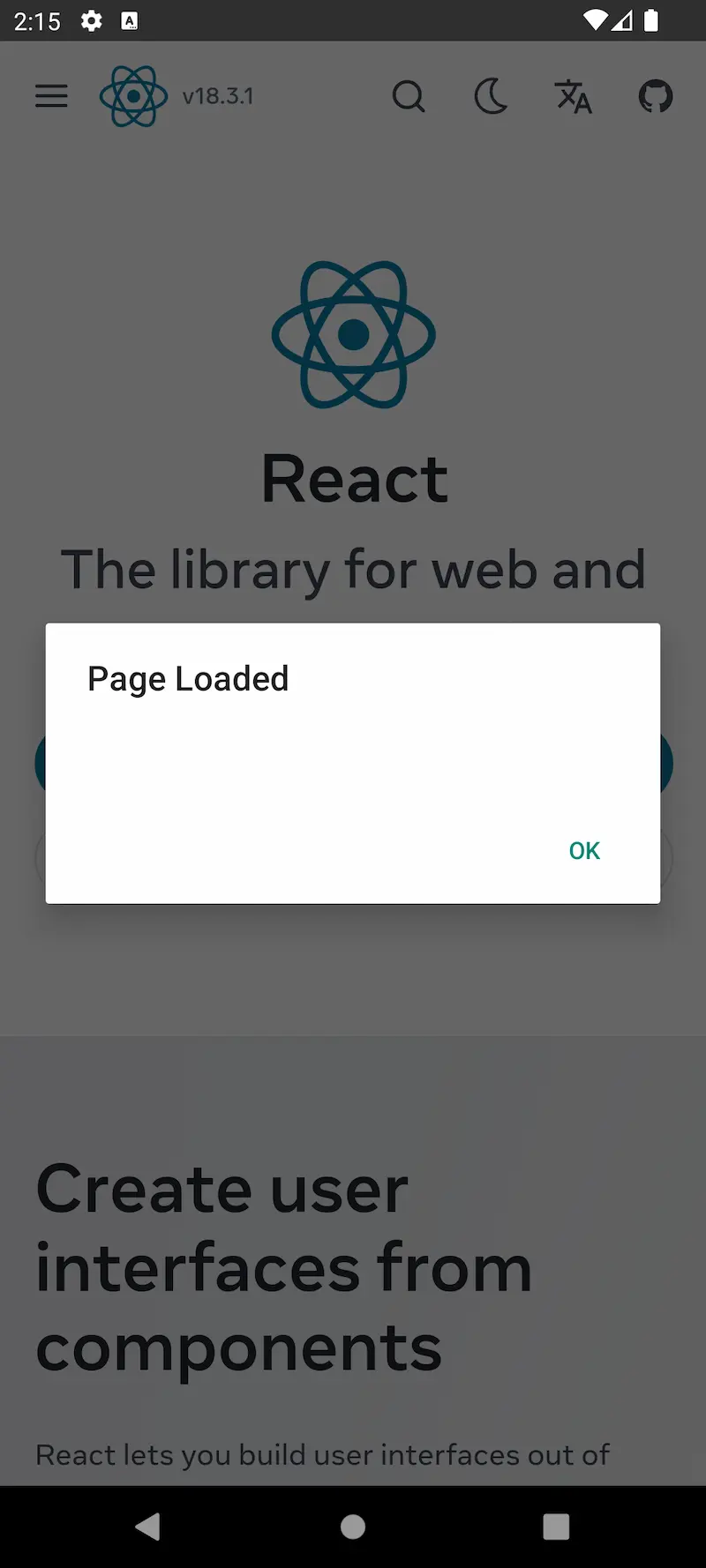
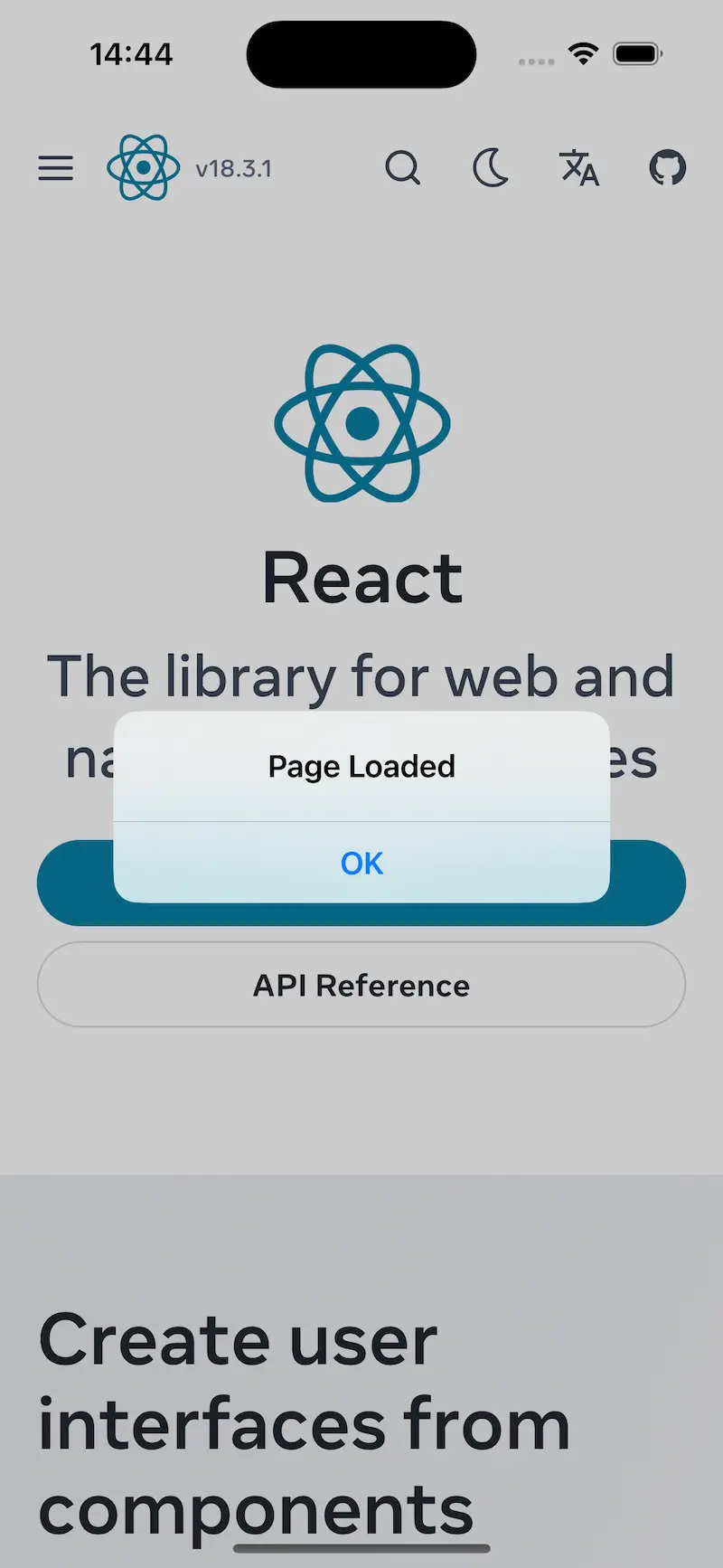
此代码创建了一个应用,该应用使用我们创建的新 WebView 组件来加载 react.dev 网站。
当网页加载完成后,应用还会显示一个弹窗。
4. 使用 WebView 组件运行你的 App
- Android
- iOS
yarn run android
yarn run ios
| Android | iOS |
|---|---|
 |  |